


Research
Research conducted within the Local Sustainability Transition and Well-being Chair at GEM examines transformations in lifestyles, organizational forms and economic models at the local scale, with the aim of supporting ecological, economic and social transitions towards more sustainable pathways and enhanced well-being. Structured around four complementary research streams, the Chair’s work combines empirical investigations, applied research and experimental approaches. It results in reports for a broad audience, academic publications and doctoral supervision, while being firmly embedded in a collaborative research dynamic closely connected to public authorities and economic actors.

Presentation
Research conducted within the Local Sustainability Transition and Well-being Chair is structured around four main thematic areas. The Chair produces reports and articles aimed at a broad audience, while also contributing to academic knowledge through publications in peer-reviewed journals. Its research activities support the training of early-career researchers, notably through PhD and CIFRE doctoral supervision. More broadly, the Chair is embedded within its local research ecosystem and actively contributes to inter-institutional research dynamics developed at the local level.
Sustainable lifestyles and socio-ecological practices
This research stream focuses on understanding how lifestyles are evolving in response to major socio-ecological challenges. Drawing on both socio-economic surveys and experimental research designs, these studies aim to better understand the links between socio-economic practices and behaviors and environmental sustainability. Topics addressed include mobility, heatwaves, water use, air quality, socio-ecological inequalities, waste, and related issues.

ADEME Report – Well-Being and Sufficiency Indicators – 2026
ADEME Report – Well-Being and Sufficiency Indicators: How Can Public Policy Be Guided in Terms of Use? – 2026 (In French) – Fiona Ottaviani, Lola Mercier Valero – GEM-ADEME
The report sheds light on five major areas of application—from supporting emerging initiatives to steering public policies—drawing on concrete examples, methodological choices, and key points of attention. It aims to facilitate the uptake of well-being approaches while strengthening the articulation between social and environmental dimensions.

Ecological Practices Report
Ecological Practices Report – 2023 (in French), Vincent Jourdain, Fiona Ottaviani, Grenoble Ecole de Management – Grenoble Alpes Métropole – ADEME.
This survey seeks to identify the factors that encourage environmentally friendly practices in everyday life, across themes such as food, mobility, consumption and energy.
Focus on two recent academic contributions
- Jourdain V., Lamah M. E. (2024) – Fostering and slackening consumption, downstream and upstream: Consumers’ roles in the French circular economy,
Journal of Cleaner Production, vol. 467
This article analyses the role of French consumers in the circular economy. It shows that formal Extended Producer Responsibility schemes foster circular practices, while informal circuits (second-hand, repair, maintenance) also play a key role. The authors recommend broadening incentives and promoting a repair culture.
- Ottaviani F. (2024) – Sustainable Well-Being Indicators and Public Policy: A Cluster Analysis,
Forum for Social Economics, vol. 53(1)
This article demonstrates the relevance of cluster analysis for studying sustainable well-being by focusing on people rather than places. Applied to Grenoble, it identifies vulnerable profiles and supports renewed approaches to public action by highlighting heterogeneous situations and new intervention levers. Article available upon request.
New forms of local organization
This core research area is structured around three complementary strands:
- the analysis of local platforms, with a particular focus on social and industrial infrastructures (shared use of facilities, brownfield sites, etc.)
- the assessment of local impact and well-being to better understand the effects of ongoing transformations
- the study of local attractiveness and ecosystems in order to identify levers that strengthen the capacity of places to respond to systemic crises.

Shared Infrastructures: Reimagining Shared Spaces for Multiple Uses – 2025
“Shared Infrastructures: Reimagining Shared Spaces for Multiple Uses ” – 2025 (in French), Sylvain Bouchard, Albane Grandazzi, Fiona Ottaviani, Hélène Picard, GEM
Libraries, schools, care homes and company premises can be opened to activities and users beyond their original purpose. The study explores emerging practices of shared and multi-use spaces in public and social infrastructure. “This white paper, produced by the Chair, is intended for professionals interested in the implementation of this approach.”
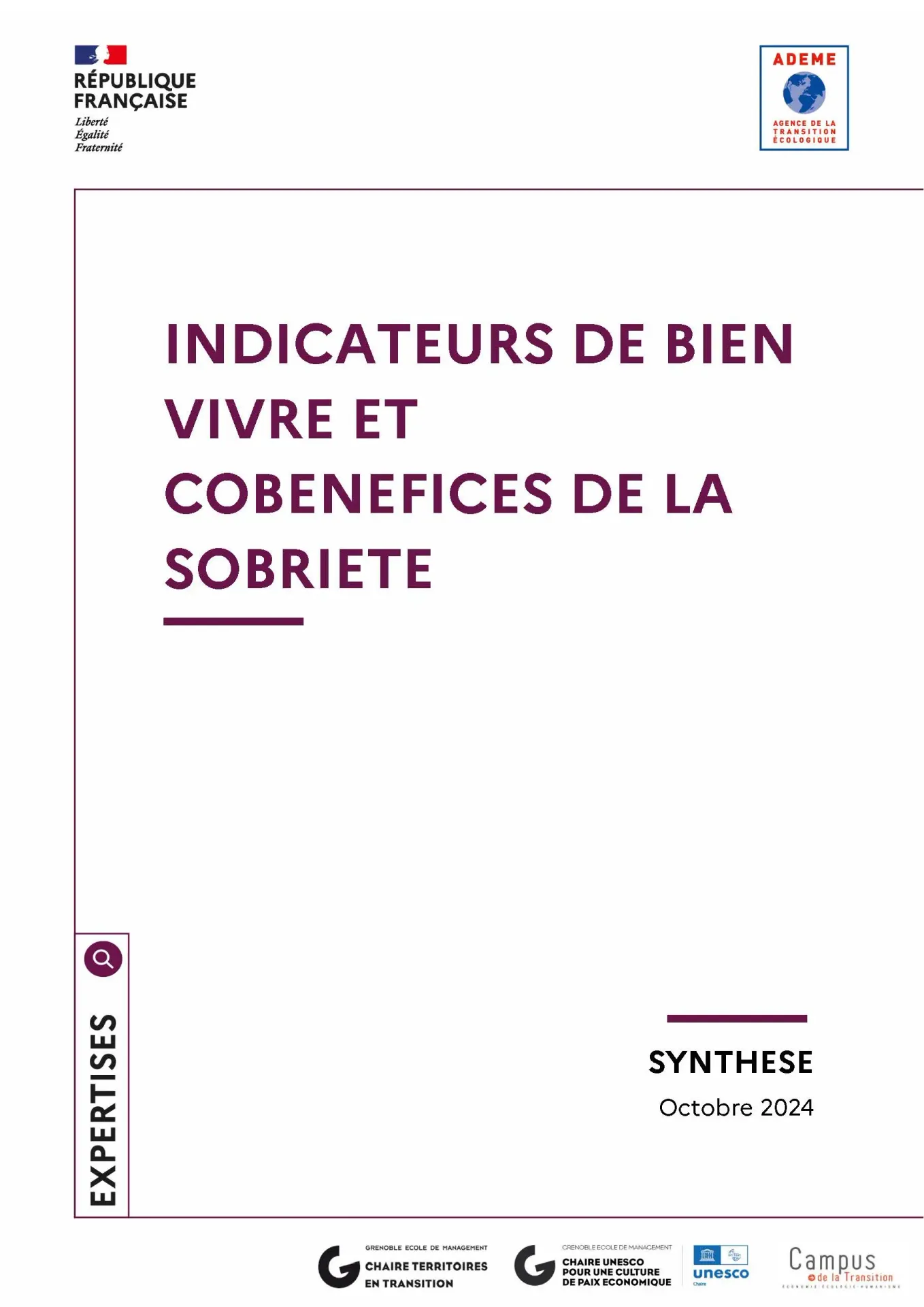
Well-being indicators and the co-benefits of sufficiency – 2024
“Well-being indicators and the co-benefits of sufficiency”, 2024, A study led for the Ecological Transition Agency (ADEME in French) by Ottaviani Fiona (Local Sustainability Transition and Well-being Chair, GEM), L’Huiller Hélène and Argoud Fanny (Campus de la transition), in French.
This ADEME report synthesizes 17 initiatives (in France and internationally) aimed at developing well-being indicators. It assesses the social and environmental co-benefits associated with well-being approaches, highlighting the importance of non-material practices compatible with sufficiency and of integrated social and environmental sustainability frameworks.
Focus on two recent academic contributions
- Bally F., Grandazzi A., Picard H., Daudigeos T. (2024) – Digital and disembedded? Questioning the local embeddedness of digital platforms, Journal of Business Ethics
This article examines how local digital platforms claim embeddedness in response to ethical challenges associated with platform capitalism. It proposes an eleven-dimension typology revealing a continuum of embeddedness and offers a critical perspective on alternatives to platform capitalism. Article available upon request.
- Bally F., Daudigeos T., Calamel L., Tallec J. (2025) – Where and how do social entrepreneurs access resources in the early stages of their ventures? A relational chain typology of French social ventures, Journal of Business Research, 201, 115732
Based on fieldwork with 40 social enterprises in the Grenoble area, this study shows that entrepreneurs primarily rely on local actors and organizations to access resources, while founders’ personal networks play a smaller role than expected.
The Chair supports doctoral research
Fiona Ottaviani co-supervised Éléonore Lavoine’s PhD dissertation, “Integrating place-based systems into impact evaluation” (in French), defended in December 2024. The thesis proposes a systemic, multidimensional and multilevel framework (MOSA) for impact evaluation (MOSA in French for: Material, Organisational and Relational, Symbolic and Political, and Administrative).
Experiential tools and transition support mechanisms
This research stream aims to design and experiment with collective intelligence tools and design fiction approaches to strengthen collaboration among local actors facing complex sustainability challenges. It relies on serious games, immersive formats and innovation catalysts that foster engagement and co-creation.

Net Zero Land Take (ZAN): turning a constraint into an opportunity for regeneration – 2025
Fifteen public and private actors from the Grenoble ecosystem participated in the 2023–2024 cycle of the Local Innovation Catalyst led by the Chair. The focus was on Net Zero Land Take and the question of how regulatory constraints can become opportunities for regeneration.
Focus on two recent academic contributions
- Li C., Michel H. (2023) – “Dear Classroom, Long Time No See…”,Academy of Management Learning & Education, vol. 22(3)
Based on 49 letters collected via the Fabularium, this study shows how management students expressed emotions and nostalgia related to distance learning during COVID-19, shedding light on adaptation strategies and emotional well-being. Article available upon request.
- Michel H., Parmentier G., Sheet Z. (2025) – Serious Games as a Provocative Research Method? In Serious Games and Innovation Gains, ISTE Editions
This chapter explores how games can support applied research, focusing on learning from failure and its effects on motivation, creativity and risk-taking.
Ecological and economic transitions in mountain areas
This research stream supports the transformation of economic models in mountain areas. It examines how resorts reinvent themselves, the emergence of large-scale development projects and the evolution of governance arrangements. Workshops are conducted with mountain stakeholders to co-develop a “compass” to guide transition pathways.
![Cahier Tendances Montagne[s] #6](https://www.grenoble-em.com/wp-content/uploads/Cahier-Tendances-Montagnes-6.jpg?ver=1768822565)
“Water and transition in mountain areas” - 2025
“Water and transition in mountain areas” – Thomas Bolognesi, Mountain Trends Notebook #6 (2024–2025) in French
What if socio-economic development in mountain areas were structured around transition experiences rather than solely agricultural and tourism outputs?
![Cahier Tendances Montagne[s] #5](https://www.grenoble-em.com/wp-content/uploads/Cahier-Tendances-Montagnes-5.jpg?ver=1768822436)
Restoring places: the doughnut recipe - 2023/2024
“Restoring places: the doughnut recipe” – Fiona Ottaviani, Mountain Trends Notebook #5 (2023–2024) in French
The doughnut model is a powerful visualization tool linking social foundations and planetary boundaries—but can it also guide regeneration processes?
Focus on two recent academic contributions
- Bolognesi T., Fischer M. (2025) – Policy Design and Governance Effectiveness, Governance, 38(4)
This article shows that effective urban water management depends on balanced combinations of participation, regulation and economic instruments, whose effects vary across contexts.
- Vindevoghel V. (2024) – Rethinking the geography of sustainability transitions by considering human-nature connections in rural areas, Environmental Innovation and Societal Transitions, 51 100851.
Based on research in French mountain areas, this study shows that proximity to nature strengthens human–nature connections and generates valuable knowledge for sustainability transitions, highlighting the role of tourism and renewed governance arrangements.
The Chair supports doctoral research projects
Thibault Daudigeos co-supervised Vincent Vindevoghel’s PhD dissertation, “From Human–Nature Dichotomy to Interdependencies between Humans and Non-Humans”, defended in July 2025. The thesis demonstrates that reconnecting humans with nature and recognizing the role of living systems can make ecological transitions fairer and more effective. It proposes to rethink collective action in response to environmental crises by taking into account local contexts and their specificities.